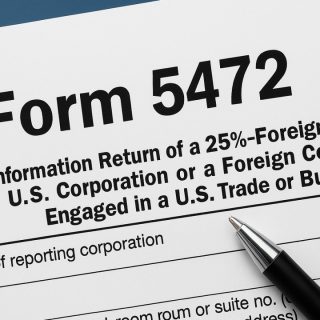
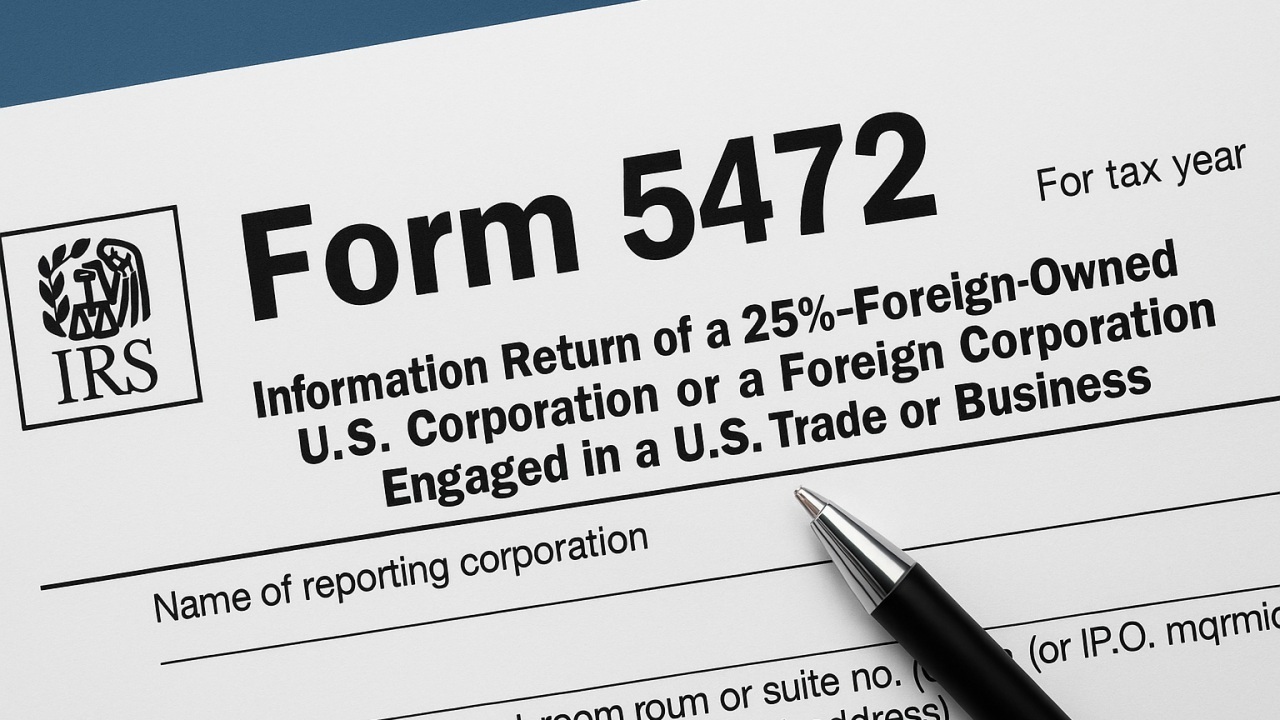

Form 5472 foreign-owned LLC • foreign-owned single-member LLC filing • Section 6038A reporting • $25,000 IRS penalty • pro forma Form 1120 • Rockville international tax attorney
Form 5472 for Foreign-Owned Maryland LLCs: What Non-U.S. Owners Must Know Before the $25,000 Penalty
Key Points
- A Maryland LLC wholly owned by a non-U.S. person is treated as a corporation for one narrow purpose: information reporting under Section 6038A. It stays disregarded for income tax generally.
- When Form 5472 is required, the foreign-owned U.S. disregarded entity files it with a pro forma Form 1120, even though the LLC has no income tax return filing requirement of its own and may owe no tax at all. These entities also generally need an EIN for Section 6038A reporting.
- For these entities, Part V is unusually broad. Contributions to and distributions from the LLC, and amounts tied to its formation or dissolution, can themselves be reportable.
- The penalty is $25,000 for failing to file or for filing a substantially incomplete form, with more accruing every 30 days once 90 days pass after IRS notice.
- These filers cannot e-file. There is a dedicated fax number and Ogden mailing address, and using the ordinary Form 1120 address is a common mistake.
- Under Section 6501(c)(8), an unfiled Form 5472 can keep the related assessment period open rather than letting it expire.
- Fixing missed years usually starts with delinquent filings plus reasonable cause. Talk with an international tax attorney before self-assessing.
The filing nobody mentioned at formation
A $25,000 problem hiding inside a routine LLC
An engineer living abroad forms a single-member Maryland LLC to hold a rental condominium in Silver Spring. An entrepreneur in Lagos sets up a Maryland LLC to invoice U.S. clients. An investor in Seoul forms a Maryland LLC that will hold funds while a project gets off the ground and does almost nothing for two years. In each case the formation was handled online, took twenty minutes, and produced a clean set of documents.
None of them was told that the LLC may now owe the IRS an information return for any year in which it has a reportable transaction, that the filing can be required even if the company earned no income and owes no tax, and that missing a required filing carries a penalty starting at $25,000.
This is not an obscure trap for large multinationals. It is the routine consequence of a 2016 regulation that pulled foreign-owned single-member LLCs into a reporting regime originally built for foreign-owned corporations. Formation services and general business advisors frequently miss it, because from a state-law and income-tax perspective nothing about the LLC looks unusual. The obligation lives entirely in federal information reporting.
This guide explains who has to file Form 5472, why a disregarded entity files anything at all, what counts as a reportable transaction, the unusual filing mechanics, the penalty structure, what happens to the statute of limitations, how to fix missed years, and how the federal obligation sits alongside your Maryland filings. If your entity was formed outside Maryland but operates here, our guide on foreign LLC registration in Maryland covers the state-side companion problem.
Who has to file Form 5472
Reporting corporations and 25 percent foreign shareholders
Form 5472 exists to give the IRS visibility into transactions between U.S. entities and their foreign related parties. It reports information required under Internal Revenue Code Section 6038A and Section 6038C. It does not calculate tax. It is a disclosure return.
The IRS instructions to Form 5472 define a reporting corporation as either:
- A 25 percent foreign-owned U.S. corporation, including a foreign-owned U.S. disregarded entity; or
- A foreign corporation engaged in a trade or business within the United States.
A corporation is 25 percent foreign owned if it has at least one direct or indirect 25 percent foreign shareholder at any time during the tax year. A foreign person is generally a 25 percent foreign shareholder if it owns, directly or indirectly, at least 25 percent of either the total voting power of all classes of stock entitled to vote, or the total value of all classes of stock. The constructive ownership rules of Section 318 apply with modifications, which means ownership through other entities and through family members can count.
A foreign person includes an individual who is not a citizen or resident of the United States, an individual who is a citizen or resident of a U.S. possession and not otherwise a U.S. citizen or resident, any partnership, association, company, or corporation not created or organized in the United States, a foreign estate or trust, and in defined circumstances a foreign government. The term does not include an individual for whom a joint-return election under Section 6013(g) or (h) is in effect.
Finally, a related party is any direct or indirect 25 percent foreign shareholder, any person related to the reporting corporation or to such a shareholder within the meaning of Section 267(b) or 707(b)(1), or any other person related to the reporting corporation within the meaning of Section 482. Generally, a reporting corporation must file Form 5472 if it had a reportable transaction with a foreign or domestic related party during the tax year, and a separate Form 5472 is filed for each such related party.
The disregarded entity rule that changes everything
Why a single-member LLC becomes a corporation for one purpose
Here is the provision that catches non-U.S. owners of Maryland LLCs. Ordinarily, a domestic single-member LLC that has not elected corporate treatment is disregarded as an entity separate from its owner for federal income tax purposes. It files nothing. Its activity shows up on the owner’s return, if the owner has one.
In December 2016, Treasury and the IRS issued final regulations, T.D. 9796, that changed this for one category of entity. As the Form 5472 instructions summarize it, a foreign-owned U.S. disregarded entity is a domestic disregarded entity wholly owned by a foreign person, and for tax years beginning on or after January 1, 2017, and ending on or after December 13, 2017, such an entity is treated as an entity separate from its owner and classified as a corporation for the limited purposes of the Section 6038A requirements that apply to 25 percent foreign-owned domestic corporations.
Two points deserve emphasis:
- The reclassification is narrow. The LLC is not becoming a corporation for income tax purposes. It is not suddenly paying corporate tax. It is pulled out of disregarded status only for reporting and record maintenance under Section 6038A.
- The reclassification is complete for that purpose. Within its scope, the entity is a reporting corporation with all that follows: it needs an EIN, it has a filing obligation, and it is exposed to the Section 6038A penalty regime.
The regulations also address indirect ownership, reaching ownership held entirely through one or more other disregarded entities or grantor trusts, whether domestic or foreign. Layering an LLC under another disregarded structure does not avoid the rule.
Why Treasury did this. Before these regulations, a foreign-owned U.S. disregarded entity and its foreign owner might have no U.S. return or information return obligation at all, which meant the United States had no systematic visibility into the entity or its owner. That created a gap in the information the government needed to meet its obligations under tax treaties and information exchange agreements. The regulations closed the gap by requiring an annual disclosure rather than by imposing tax. Understanding that purpose helps explain why the filing is required even when nothing is owed.
What counts as a reportable transaction
Part IV, Part VI, and the very broad Part V
The filing obligation is triggered by a reportable transaction with a related party. The instructions define a reportable transaction as any type of transaction listed in Part IV of the form for which monetary consideration was the sole consideration paid or received, any transaction listed in Part V, or any transaction or group of transactions listed in Part VI.
Part IV covers monetary transactions with a foreign related party: sales and purchases of inventory and other property, rents and royalties paid and received, platform contribution and cost sharing payments, interest, premiums, commissions, amounts borrowed and amounts loaned, and catch-all categories for other amounts received and paid. Part VI covers nonmonetary transactions and transactions for less than full consideration with a foreign related party, described on an attached schedule.
Part V is the one that matters most for a foreign-owned LLC, and it is much broader than owners expect. The instructions direct a foreign-owned disregarded entity to check the Part V box if it had any other transaction as defined by Regulations section 1.482-1(i)(7) that is not already entered in Part IV, and state that these transactions include amounts paid or received in connection with the formation, dissolution, acquisition, and disposition of the entity, including contributions to, and distributions from, the entity. Those transactions are described on an attached statement.
Contributions to the entity and distributions from it are reportable. So are amounts connected with forming the entity. In practice this means the owner wiring money into the LLC’s bank account, the owner paying a formation or maintenance cost on the entity’s behalf, or the entity sending money back to the owner can each constitute a reportable transaction, even in a year with no revenue, no customers, and no profit. Many owners who believe they have a filing exception do not.
There is a genuine exception, but it is narrow. The instructions provide that a reporting corporation is not required to file if it had no reportable transactions of the types listed in Parts IV and VI and, in the case of a foreign-owned U.S. disregarded entity, also had no reportable transactions of the type listed in Part V. Several other exceptions exist for ordinary reporting corporations, including one for cases where a U.S. person files Form 5471 with a completed Schedule M and one for certain foreign corporations with no U.S. permanent establishment under a treaty. Note carefully that the instructions state several of those exceptions do not apply to foreign-owned U.S. disregarded entities.
Two practical mechanics worth knowing. If an actual amount in a transaction or series of transactions with a foreign related party does not exceed $50,000 in total, the instructions permit reporting it as “$50,000 or less.” And where actual amounts are not determinable, the instructions permit reasonable estimates, defined as an amount that is at least 75 percent but not more than 125 percent of the actual amount required to be reported.
How and when to file
The pro forma Form 1120 workaround
Form 5472 is normally filed as an attachment to the reporting corporation’s income tax return. That creates an obvious problem for a disregarded entity, which has no income tax return. The IRS solved it with a workaround that is unusual enough to cause errors on its own.
As the instructions put it, while a foreign-owned U.S. disregarded entity has no income tax return filing requirement, as a result of the final regulations it is required to file a pro forma Form 1120 with Form 5472 attached, by the due date including extensions of that Form 1120. The only information required to be completed on the Form 1120 is the name and address of the entity and items B and E on the first page. The instructions direct that “Foreign-owned U.S. DE” be written across the top of the Form 1120.
The tax year. The entity uses the same tax year as its owner for U.S. tax filing purposes, or the calendar year if the owner has no such filing requirement.
The filing channel is the part people get wrong. The instructions are explicit that a foreign-owned U.S. disregarded entity cannot file Form 5472 electronically, and that these filers must use a dedicated address rather than the ordinary Form 1120 mailing addresses. The instructions specify filing by fax at 300 DPI or higher to 855-887-7737, or by mail to:
Internal Revenue Service
1973 Rulon White Blvd
M/S 6112, Attn: PIN Unit
Ogden, UT 84201
Extensions. The entity can request more time by filing Form 7004 by the regular due date of the return, entering the code for Form 1120 on Part I, line 1, writing “Foreign-owned U.S. DE” across the top, and sending it to the same dedicated fax number or mailing address rather than the ordinary Form 7004 address.
Before any of this, you need an EIN. An entity that was previously disregarded and inactive often has no employer identification number at all. Obtaining one for a foreign-owned entity whose responsible party has no U.S. taxpayer identification number is its own process and is frequently the longest lead time in the whole exercise. Start it early rather than in the week before a deadline. Filing addresses, fax numbers, and form procedures also change from time to time, so confirm the current instructions on IRS.gov before you file.
The penalty structure
$25,000, and then more
The penalty is what makes this worth attention. Straight from the IRS instructions:
- A $25,000 penalty will be assessed on any reporting corporation that fails to file Form 5472 when due and in the manner prescribed. The same penalty applies for failure to maintain records as required by Regulations section 1.6038A-3.
- An incomplete form counts as no form. The instructions state plainly that filing a substantially incomplete Form 5472 constitutes a failure to file Form 5472.
- Continuation penalties. If the failure continues for more than 90 days after notification by the IRS, an additional $25,000 penalty applies. That penalty applies with respect to each related party for which a failure occurs, for each 30-day period or part of a 30-day period during which the failure continues after the 90-day period ends.
- Per related party, per year. Because a separate Form 5472 is required for each related party with which there was a reportable transaction, exposure multiplies across parties and across open years.
- Criminal exposure exists. The instructions note that criminal penalties under sections 7203, 7206, and 7207 may apply for failure to submit information or for filing false or fraudulent information.
Note also the phrase “in the manner prescribed.” Because the manner prescribed for these entities includes the pro forma Form 1120 and the dedicated fax or mailing address, a Form 5472 sent through the wrong channel is not obviously a completed filing. That is a procedural risk worth taking seriously rather than assuming substance will excuse form.
Context on enforcement of information return penalties. Taxpayers facing international information return penalties have in recent years litigated whether the IRS may assess certain of them administratively rather than having to sue to collect. That question arose most prominently under a different Code section governing Form 5471 penalties, and appellate decisions have been going the government’s way, including the Second Circuit’s February 2026 decision in Safdieh v. Commissioner. The details differ across Code sections and the law continues to develop, so the direct application to Section 6038A penalties should be evaluated on your specific facts with counsel. The general direction of travel, however, is toward easier assessment and collection, not harder.
The clock that never starts
Section 6501(c)(8) and the open assessment period
Business owners often assume that an old problem eventually becomes a safe problem. For international information returns, that assumption is unreliable.
Internal Revenue Code Section 6501(c)(8) provides that, in the case of information required to be reported under a list of provisions that expressly includes Section 6038A, the time for assessment of any tax imposed by the title with respect to any tax return, event, or period to which the information relates shall not expire before the date three years after the date on which the IRS is furnished the required information.
Read practically: Section 6501(c)(8) prevents the assessment period for tax relating to the unreported information from expiring before three years after the required information is furnished to the IRS. An unfiled Form 5472 can therefore keep an otherwise expiring assessment period open for tax relating to the missing information. If the failure to furnish the information was due to reasonable cause and not willful neglect, however, the special extension applies only to the item or items related to that failure.
If unfiled returns are part of a broader pattern, our guide on unfiled tax returns and back taxes covers the wider cleanup process.
Fixing missed years
Coming forward before the IRS finds you
Whether the IRS has already contacted the taxpayer is an important practical consideration in a delinquent Form 5472 matter. Correcting the filing before IRS contact can put the taxpayer in a better procedural and factual posture, but it does not itself determine whether penalty relief is available. Reasonable cause under the Section 6038A regulations remains a facts-and-circumstances inquiry, including where a penalty has already been proposed or assessed.
The typical path involves several steps:
- Determine every year and every entity affected. Foreign owners frequently hold more than one U.S. entity, and each requires its own analysis. Within each year, identify each related party with reportable transactions, since each requires a separate form.
- Reconstruct the reportable transactions, paying particular attention to Part V items such as capital contributions, owner-paid expenses, and distributions that owners rarely think of as transactions.
- Assess the character of the failure honestly and with counsel. This is not a self-assessment exercise. Characterizing conduct incorrectly in a submission to the IRS can create exposure well beyond the original penalty.
- File the delinquent forms with a reasonable cause statement. Reasonable cause generally requires showing ordinary business care and prudence. A specific, documented explanation is far stronger than a general assertion of ignorance.
- Consider penalty relief avenues, principally reasonable cause under the Section 6038A regulations, and be prepared to contest an assessed penalty through the examination and appeals process. First Time Abate does not apply to Form 5472 penalties.
If a penalty has already been assessed, it is not necessarily the end of the matter. Penalty defense often turns on procedural requirements the IRS must satisfy, a subject we cover in our post on Section 6751(b) penalty defense, and the broader process is mapped in our ten steps to navigate a civil tax controversy and our overview of IRS and state tax appeals.
Do not quietly begin filing going forward and hope the earlier years are overlooked. Because Section 6501(c)(8) keeps the related assessment period open for the unfiled years, silence does not resolve them, and a first-time-filer checkbox on the current form can invite the question of what happened before. A deliberate, documented correction is a materially better posture than a partial one.
Form 5472 versus Form 5471
Inbound and outbound, easily confused
These two forms are frequently mixed up, including by advisors. They point in opposite directions.
| Form 5472 | Form 5471 | |
|---|---|---|
| Direction | Inbound. Foreign ownership of a U.S. entity | Outbound. U.S. ownership of a foreign corporation |
| Who files | The U.S. reporting corporation, including a foreign-owned U.S. disregarded entity | The U.S. person with the qualifying interest |
| Ownership threshold | 25 percent foreign shareholder, by vote or value | Generally 10 percent, with several filer categories |
| Code section | Sections 6038A and 6038C | Sections 6038 and 6046 |
| Base penalty | $25,000 per form, with continuation penalties after 90 days | $10,000 per form per year, with continuation penalties |
A single structure can trigger both. A U.S. corporation with foreign shareholders that also owns a foreign subsidiary may file Form 5472 for the inbound relationships and Form 5471 for the outbound one. The short diagnostic: if you are a non-U.S. person who owns a U.S. company, think Form 5472. If you are a U.S. person who owns shares in a company organized abroad, think Form 5471.
The Maryland layer
Federal reporting is only half the compliance picture
Form 5472 is a federal information return. Filing it does not change anything you owe Maryland, and Maryland does not administer it. But foreign owners who miss the federal obligation very often have gaps on the state side too, because both stem from the same cause: an entity formed quickly online without advice about what comes after formation.
A Maryland LLC with a non-U.S. owner should also be attending to:
- A Maryland resident agent. The entity needs one continuously, and a non-resident owner cannot serve in that role personally.
- The Maryland Annual Report filed with the State Department of Assessments and Taxation, plus a business personal property return where applicable. Missing these leads to loss of good standing and eventually forfeiture, as our guide on a Maryland business not in good standing explains.
- Foreign entity registration, if the LLC was formed in Delaware or Wyoming but actually operates in Maryland. See our guide on foreign LLC registration in Maryland.
- Maryland tax accounts with the Comptroller where the activity requires them, along with any licensing.
- Income tax exposure on U.S. and Maryland source income, which is a separate analysis from the information reporting question and depends on the nature of the activity, any applicable treaty, and whether the income is effectively connected with a U.S. trade or business. Rental real estate in particular carries its own set of elections and withholding rules.
If you are still choosing where to form, our guide on whether Maryland small businesses should form an LLC in Maryland, Delaware, or Wyoming is worth reading first, because the formation state affects the state-side compliance load without changing the Form 5472 obligation at all.
Common mistakes owners make
The avoidable errors
- Assuming a disregarded entity files nothing. True for income tax. Not true for Section 6038A reporting once the owner is a foreign person.
- Assuming no income means no filing. The trigger is a reportable transaction, not profit. Contributions and distributions can be enough.
- Treating funding the LLC as a non-event. Part V expressly reaches contributions to and distributions from the entity.
- Filing to the wrong address or trying to e-file. These filers cannot e-file and must use the dedicated fax number or Ogden address.
- Submitting a partial form. A substantially incomplete Form 5472 is treated as a failure to file.
- Waiting on the EIN. Obtaining an EIN for a foreign-owned entity takes time and is often the binding constraint on meeting the deadline.
- Believing old years are safe. Section 6501(c)(8) can keep the related assessment period open until the missing information is furnished.
- Self-certifying the reason for the failure. How you characterize your own conduct in a submission to the IRS has consequences beyond the form itself.
- Confusing Form 5472 with Form 5471. Different direction, different threshold, different penalty.
- Fixing the federal problem and ignoring Maryland. Resident agent, annual report, and good standing obligations run in parallel.
How Iqbal Business Law can help
Iqbal Business Law advises non-U.S. owners of U.S. entities and U.S. businesses with foreign ownership on cross-border reporting obligations and the penalties that follow when they are missed. Because our practice combines business law with a full tax controversy and international compliance practice, we can handle the entity structure, the federal reporting, and any resulting IRS penalty exposure together. Our work in this area includes:
- Determining whether an entity is a reporting corporation and whether reportable transactions occurred, including the Part V analysis for foreign-owned disregarded entities
- Obtaining EINs for foreign-owned entities whose responsible party has no U.S. taxpayer identification number
- Preparing and filing Form 5472 with the pro forma Form 1120 through the correct dedicated channel, and handling Form 7004 extensions
- Correcting delinquent filings across multiple years and entities, with supported reasonable cause statements
- Defending assessed penalties in examination and appeals, including procedural challenges
- Advising on the interaction with Form 5471, FBAR, and other international reporting where a structure triggers more than one obligation
- Structuring U.S. entities for non-U.S. owners with the reporting burden accounted for from day one
- Coordinating the Maryland side: entity formation or registration, resident agent, annual report, and good standing
We serve business owners throughout Maryland from our offices in Frederick and Rockville, including Rockville, Bethesda, Gaithersburg, Silver Spring, Frederick, Montgomery County, and the surrounding region, and we are licensed in Maryland and Pennsylvania.
Related reads and resources
IRS guidance and authority
- IRS, Instructions for Form 5472
- IRS, About Form 1120 (used as the pro forma return)
- IRS, About Form 7004 (extension of time to file)
- T.D. 9796, final regulations on foreign-owned domestic disregarded entities (Federal Register)
- Internal Revenue Code Section 6038A (Cornell Legal Information Institute)
- Internal Revenue Code Section 6501 (limitations on assessment, including 6501(c)(8))
- Internal Revenue Manual 20.1.9, International Penalties
Maryland agencies
- Maryland State Department of Assessments and Taxation (SDAT)
- Maryland Business Express (entity search and filings)
- Comptroller of Maryland (business tax accounts)
Related Iqbal Business Law insights
- Do You Need to Register as a Foreign LLC in Maryland?
- Should Maryland Small Businesses Form an LLC in Maryland, Delaware, or Wyoming?
- Maryland Business Not in Good Standing: SDAT Forfeiture
- Unfiled Tax Returns and Back Taxes in Maryland and Pennsylvania
- IRS Civil Tax Penalty Defense and Section 6751(b)
- 10 Steps to Navigate a Civil Tax Controversy
- What Triggers an IRS Audit? 12 Red Flags Every Business Owner Must Know
- LLC vs. Corporation: Tax Implications and Choosing the Right Structure
FAQ
Who has to file Form 5472?
Form 5472 is filed by a reporting corporation, which the IRS instructions define as either a 25 percent foreign-owned U.S. corporation, including a foreign-owned U.S. disregarded entity, or a foreign corporation engaged in a trade or business within the United States. A corporation is 25 percent foreign owned if it has at least one direct or indirect 25 percent foreign shareholder at any time during the tax year, measured by total voting power or total value of the stock. Generally, a reporting corporation must file Form 5472 if it had a reportable transaction with a foreign or domestic related party during the year. The category that catches most people by surprise is the foreign-owned single-member LLC, which is discussed below.
My Maryland LLC is a disregarded entity. Why would it file anything?
Because a special rule turns it into a corporation for this one purpose. Under final regulations issued in December 2016 (T.D. 9796), for tax years beginning on or after January 1, 2017, and ending on or after December 13, 2017, a domestic disregarded entity wholly owned by a foreign person is treated as an entity separate from its owner and classified as a corporation for the limited purposes of the Section 6038A requirements that apply to 25 percent foreign-owned domestic corporations. The entity remains disregarded for income tax purposes generally. It is only pulled out of disregarded status for reporting and record maintenance. The practical effect is that a single-member Maryland LLC owned by a non-U.S. individual, which files no income tax return of its own, must nonetheless obtain an EIN and file Form 5472 attached to a pro forma Form 1120 when it has a reportable transaction.
What is a reportable transaction, and does funding my own LLC count?
For an ordinary reporting corporation, a reportable transaction is a monetary transaction of a type listed in Part IV of the form, such as sales, rents, royalties, interest, or amounts borrowed or loaned, or a nonmonetary or less-than-full-consideration transaction listed in Part VI. For a foreign-owned U.S. disregarded entity there is an additional and much broader category in Part V. The instructions direct a foreign-owned disregarded entity to check the Part V box if it had any other transaction as defined by Regulations section 1.482-1(i)(7) that is not already reported in Part IV, and state that these transactions include amounts paid or received in connection with the formation, dissolution, acquisition, and disposition of the entity, including contributions to and distributions from the entity. That language is why funding the LLC or taking money out of it can itself be a reportable transaction.
What if my LLC had no activity at all this year?
A genuinely dormant entity with no reportable transactions of any kind may fall within the filing exception. The instructions provide that a reporting corporation is not required to file if it had no reportable transactions of the types listed in Parts IV and VI and, in the case of a foreign-owned U.S. disregarded entity, also had no reportable transactions of the type listed in Part V. The catch is how broad Part V is for these entities. Because contributions to and distributions from the entity are reportable, an LLC that received any funding from its owner, paid any expense with owner money, or distributed anything back is unlikely to be truly transaction-free. Do not assume dormancy without walking through Part V carefully, ideally with a tax professional.
How and when is Form 5472 filed for a foreign-owned LLC?
A foreign-owned U.S. disregarded entity has no income tax return filing requirement of its own, so the IRS created a workaround. The entity files a pro forma Form 1120 with Form 5472 attached, by the due date of that Form 1120 including extensions. The only information required on the Form 1120 is the name and address of the entity and items B and E on the first page, with “Foreign-owned U.S. DE” written across the top. These filers cannot file electronically. They must use a dedicated channel: fax at 300 DPI or higher to 855-887-7737, or mail to Internal Revenue Service, 1973 Rulon White Blvd, M/S 6112, Attn: PIN Unit, Ogden, UT 84201. The entity uses the same tax year as its owner for U.S. filing purposes, or the calendar year if the owner has no U.S. filing requirement. An extension is requested on Form 7004 sent to the same dedicated address.
What is the penalty for not filing Form 5472?
The IRS instructions state that a penalty of $25,000 will be assessed on any reporting corporation that fails to file Form 5472 when due and in the manner prescribed, and that the penalty also applies for failure to maintain records as required by Regulations section 1.6038A-3. Filing a substantially incomplete Form 5472 counts as a failure to file. If the failure continues for more than 90 days after IRS notification, an additional $25,000 penalty applies with respect to each related party for which a failure occurs, for each 30-day period or part of a 30-day period during which the failure continues after the 90-day period ends. Criminal penalties under sections 7203, 7206, and 7207 may also apply for failure to submit information or for filing false or fraudulent information. A separate form is required for each related party, and each can carry its own penalty.
Does the statute of limitations protect me if I never filed?
Not in the way most people assume. Internal Revenue Code Section 6501(c)(8) provides that when information required under specified international reporting provisions, including Section 6038A, is not furnished, the period for assessing tax with respect to the return, event, or period to which that information relates cannot expire before three years after the required information is furnished to the IRS. If the reporting failure was due to reasonable cause and not willful neglect, the special extension applies only to the item or items related to the failure. The practical consequence is that an unfiled Form 5472 can keep the assessment period open for tax relating to the missing information rather than allowing that exposure simply to age out.
I missed several years. How do I fix it?
Filing the delinquent forms with a well-supported reasonable cause statement is usually the starting point. The regulations expressly permit relief where a taxpayer establishes reasonable cause, and whether reasonable cause exists depends on all the facts and circumstances. Reasonable reliance on professional advice can support reasonable cause in appropriate circumstances, but professional reliance does not automatically establish it. First Time Abate does not apply to Form 5472 penalties. Where the facts are worse than simple oversight, or where unreported income is involved, other IRS resolution paths may be appropriate. Because an incorrect characterization of your own conduct can create additional exposure, this is a point to involve a tax attorney rather than self-assess.
What is the difference between Form 5472 and Form 5471?
They are mirror images. Form 5472 is inbound: it reports foreign ownership of a U.S. entity, is filed by the U.S. reporting corporation, keys off a 25 percent foreign ownership threshold, and carries a $25,000 penalty. Form 5471 is outbound: it is filed by a U.S. person with an interest in a foreign corporation, generally keys off a 10 percent threshold, and carries a $10,000 penalty per form per year with continuation penalties. A single business structure can trigger both, for example where a U.S. corporation with foreign shareholders also owns a foreign subsidiary. If you are a U.S. person who owns shares in a company organized outside the United States, Form 5471 rather than Form 5472 is generally your concern.
Does this affect my Maryland filings too?
Form 5472 is purely a federal information return, so it does not change what you file with Maryland. But a foreign-owned Maryland LLC has a parallel set of state obligations that are easy to overlook in the same way: the entity must maintain a Maryland resident agent, file the Maryland Annual Report with the State Department of Assessments and Taxation, file a business personal property return where applicable, and stay in good standing. If the LLC was formed in Delaware or Wyoming but operates in Maryland, it may also need to register here as a foreign entity. Non-U.S. owners frequently set up through an out-of-state formation service and end up with gaps on both the federal reporting side and the Maryland compliance side at once.
Disclaimer: This post is for general informational and educational purposes only and does not constitute legal or tax advice. Every situation is fact-specific, and the information provided may not reflect the most current legal, regulatory, or administrative developments, including IRS forms, filing addresses, and procedures that change from time to time. Reading this post does not create an attorney-client relationship with Iqbal Business Law. For advice specific to your situation, consult a qualified tax attorney.